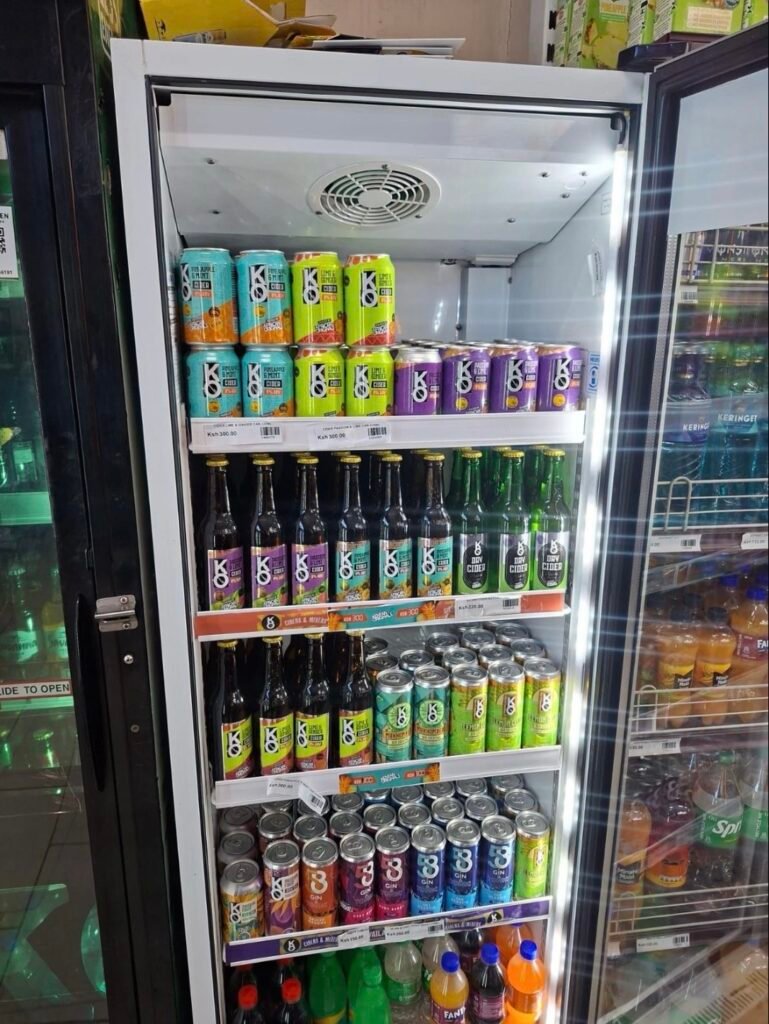
While EABL’s beer empire commands roughly nine-in-ten shillings spent on lager in Kenya, a Nairobi distillery has quietly built a challenger business worth tens of millions of dollars, by declining to compete in beer at all.
Every commercial strategist in East Africa had been told the same, EABL is unbeatable in beer. The Diageo subsidiary has held the category since 1922, and as recently as 2020 controlled roughly nine in ten shillings of Kenyan beer sales, according to Statista figures on brewery market share. Keroche, the closest local rival, registered a market share in the low single digits. The arithmetic tells every challenger brand the same thing: don’t fight here.
Alexandra Chappatte read the arithmetic and made a different move. She didn’t try to out-brew EABL. She built a company that refuses to make beer at all.
The category EABL doesn’t own
Chappatte founded Kenya Originals, the company behind the KO label, in 2018, after a career running West African marketing for Pernod Ricard, the world’s second-largest wine and spirits house. She had noticed a gap across markets she’d worked in: a saturated beer category flanked by cheap mass-market options on one side and expensive imports on the other, with no quality, locally rooted alternative in between.
Her answer wasn’t a better beer. It was ciders, gins, iced teas, and mixers, distilled and blended from Kenyan-grown fruit, mango from Makueni, pineapple from Thika, lime from Garissa, passion fruit from Uasin Gishu. The company’s own position is explicit: it has no interest in touching beer, calling the category saturated and its consumer needs already well served.
This is the strategic craft worth studying. KO didn’t attack EABL’s fortress but instead built a new category next door, timed to a shift already underway in consumer behaviour.
The numbers behind the bet
The data justifies the position. Kenya’s alcoholic drinks market was valued at roughly Sh150 billion in 2023 and an estimated Sh425 billion by 2025. Within that expansion, the category mix is moving in KO’s favour. Beer still commands the majority of consumption at 62 percent, against 35 percent for spirits and 4 percent for wine, but since 2019, beer sales have declined 12 percent while spirits climbed to 53 percent growth and ciders surged 200 percent.
That cider figure is the crux of the KO thesis. Chappatte attributes the shift partly to a straightforward physical complaint, consumers who feel bloated on beer, layered onto a broader Kenyan preference for sweeter drinks, with women emerging as the highest per-capita cider consumers. A brand built entirely around cider as its largest portfolio line wasn’t chasing a trend. It was early to one already visible in the category data.
“We don’t want to touch beer. It’s very saturated in Kenya, and its needs are well met.”
Alexandra Chappatte, Founder, Kenya Originals
Distribution as the real battle
Category selection solved the “who do we compete with” problem. It did not solve distribution, and this is where the more instructive lesson for East African commercial teams sits.
Getting KO into major supermarkets required overcoming real scepticism. Retailers were unfamiliar with the product category and slow to trust that it would move off the shelf. Working through Kenya’s established third-party distributor network proved even harder, for a small brand, a product without an incumbent’s leverage simply doesn’t get prioritised. So KO built and ran its own direct distribution instead, protecting margin and control at the cost of speed.
The brand’s first sale was deliberately tribal rather than mass-market, a cider sold in December 2018 at the Blankets & Wine festival, chosen because the crowd matched the target consumer precisely. Bars came next, then supermarkets, a slow and sequenced build rather than a national launch. For a market where new FMCG listings frequently die at the retail gatekeeper stage, this sequencing is the transferable lesson, not the fruit sourcing.
Reading the regulatory landscape
Kenya’s 2025 shift to alcohol-by-volume excise taxation, replacing the old flat-rate system, hit KO’s cider line hardest, pushing per-bottle duty from roughly KSh47 to KSh59, a KSh12 gap that compresses margin directly on the brand’s biggest revenue line. The company’s response was structural, not defensive. It lowered the ABV on its gin-and-tonic range from 8% to 5% to qualify for a lower tax tier, and now builds excise increases into every annual plan as a standing assumption rather than a shock.
This is worth underlining for any brand operating across Uganda, Kenya, and Tanzania simultaneously: excise regimes are not fixed variables. They are inputs a commercial team should be modelling into product formulation and pricing architecture from day one, not reacting to after the fact.
Funding for regional expansion
The company’s Uganda expansion was backed by a $2 million raise led by Phoenix Beverages, a Mauritius-based brewer that took a minority stake and now positions the brand as African Originals outside Kenya. A regional brewer choosing to fund a company that explicitly avoids beer is itself a signal that category-adjacent growth can be a more attractive capital story than direct incumbency assault, even to industry insiders.
The Takeaway
What East African challenger brands should steal from this:
- Audit the category before the competitor. KO’s opening move wasn’t a beer study but a consumption-shift study. Model where volume is moving before choosing where to fight.
- Treat distribution as the actual moat. Product-market fit gets you a listing meeting. Direct distribution, even at higher cost, is what gets you shelf space when incumbents control the trucks.
- Build tax volatility into product design, not just pricing. ABV reformulation is a commercial lever, not just a compliance response.
- Launch narrow, then widen. A festival crowd before a supermarket shelf isn’t a resourcing constraint. It’s a targeting choice worth replicating deliberately.
Sources: Statista brewery market-share data; Trace Data Research alcohol-market figures; company statements and reporting via Business Daily Africa, March 2025.